By Naeela
Start with Sponsored Products when 1 product is the answer, add Sponsored Brands when shoppers need to discover or compare a brand, and use Sponsored Display only when you can name the audience job. Before any format gets more budget, connect its destination to product contribution, at least 30 days of stock cover or a written exception, 1 owner, and 1 review date.
Key Takeaways
- Sponsored Products is the cleanest first test because 1 click leads to 1 advertised product detail page.
- Sponsored Brands should have 1 consideration or defense job, not inherit a Sponsored Products campaign with a larger creative unit.
- Sponsored Display needs 1 named audience job because attributed sales do not prove the ad created the purchase.
- Raise budget only when the product has at least 30 days of stock cover or a written replenishment exception.
- Every campaign needs 1 shopper job, 1 destination, 1 economic threshold, 1 owner, and 1 review date.
Which Amazon sponsored ad format should you choose?
Choose the format from the shopper's next decision. The console presents products, controls, and recommendations. It does not know whether your listing can convert, whether your Store continues the ad promise, or whether another sale leaves enough contribution to justify the click.
| Format | Shopper job | Typical destination | Start here when | Stop or fix when |
|---|---|---|---|---|
| Sponsored Products | Find and buy a specific product | Product detail page | One ASIN is a credible answer to the query | The detail page, price, reviews, or contribution cannot support paid traffic |
| Sponsored Brands | Discover, compare, or defend a brand and product range | Product detail page, Brand Store, or eligible landing page | Creative and destination can continue one consideration job | The ad promise lands on a generic or stale Store page |
| Sponsored Display | Reach or re-engage a defined audience | Usually a product detail page | Prospecting, conquest, or re-engagement is explicit | Attribution cannot distinguish useful reach from demand that would have returned anyway |
Amazon groups all 3 under sponsored advertising, but they do not answer the same question. Sponsored Products mostly captures product-level intent. Sponsored Brands can shape brand or category consideration. Sponsored Display changes the targeting question from "what did the shopper search?" to "which audience should see this?"
The order is not a maturity badge. A brand does not graduate by turning on every format. It earns the next format when the existing retail system can convert the different kind of attention that format buys.
When should you start with Sponsored Products?
Start with Sponsored Products when one product is the clearest answer and its detail page is ready to close the sale. Amazon describes Sponsored Products as cost-per-click ads that use keyword or product targeting and send the shopper to the advertised product detail page (Amazon Ads).
That direct path makes the test easier to read. You can connect the target, actual search term, click, ordered product, conversion rate, and contribution without asking the shopper to navigate a Store first.
Picture a campaign for a 24-ounce insulated bottle. The query fits. The ad gets clicks. Yet the detail page opens on the wrong color variation, the hero image does not show the lid, and the offer has 18 days of stock left. Raising the bid would amplify 3 separate retail problems. It would not fix advertising.
Sponsored Products also has a budget trap. Amazon says a $100 daily budget can produce up to $3,100 in clicks during a 31-day month and that daily budgets are not paced evenly. A smaller budget may disappear in minutes if demand is high. Budget is a spending limit, not a profit control.
Use Sponsored Products first when:
- the advertised ASIN is in stock and eligible;
- the detail page answers the query cleanly;
- product-level contribution sets a maximum affordable click;
- the campaign has a named search-term review date; and
- one owner can stop spend when price, inventory, or conversion changes.
Do not start here merely because it is the easiest campaign to build. If the product page cannot earn the sale, paid traffic just produces a faster diagnosis at a higher price.
When do Sponsored Brands earn a separate job?
Use Sponsored Brands when the shopper needs to discover a brand, compare a small range, understand a product through video, or see the brand occupy an important category or branded query. The format supports image, collection, and video creative, with destinations that can include a product detail page or Brand Store depending on the campaign and account (Amazon Ads).
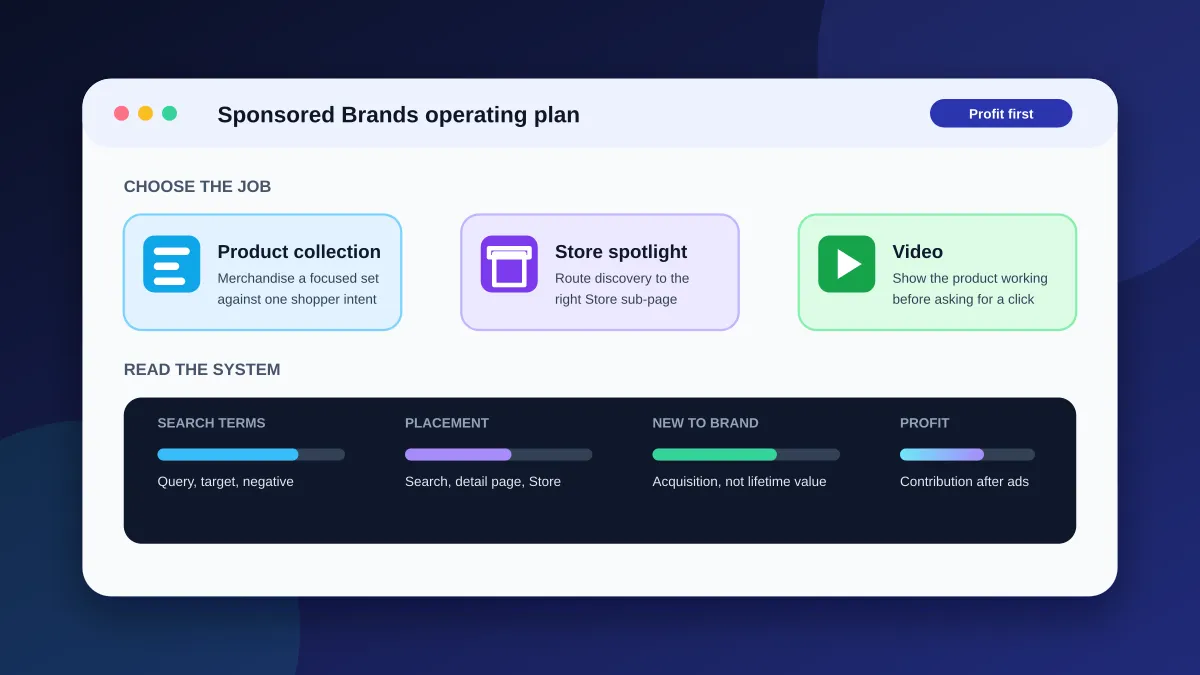
The verified Sponsored Brands model has 3 core format choices:
- Product collection works when several products form a real answer set.
- Store spotlight works when up to 3 Store routes are distinct and useful.
- Video works when a demonstration, fit question, or comparison is easier to understand visually. Amazon's current specification supports videos from 6 to 45 seconds, and they begin muted where supported.
The destination is part of the media decision. Suppose the headline promises "storage for small kitchens" but sends the click to a Store homepage organized by internal product codes. The shopper has to restart the search you already paid to interrupt. A larger ad unit created more choice, not more relevance.
Use a product detail page when one ASIN resolves the promise. Use a focused Store page when the shopper needs a range or category path. Use the broader Store only when discovery itself is the job and the first screen gives a clear route.
Sponsored Brands also needs different measurement. New-to-brand reporting uses a 12-month Amazon purchase lookback, which helps separate first-time brand orders from repeat purchase within Amazon's attribution rules. It does not prove the ad caused an incremental customer, and it says nothing about the shopper's off-Amazon history or future value.
That distinction matters because a branded defense campaign may show lower new-to-brand share by design, while a category campaign may be expected to reach unfamiliar shoppers. Comparing them on one blended number makes both harder to manage.
When is Sponsored Display the right next move?
Use Sponsored Display only after you can finish this sentence: "We want to reach this audience because they did or did not do this." The format can support audience-based reach and re-engagement on Amazon and, where available, beyond it. That is a different job from buying a keyword click.
Useful jobs include re-engaging shoppers who viewed a product but did not buy, reaching category audiences, or appearing around relevant products. Each job needs its own audience, destination, exclusion logic, economic threshold, and review window.
The strongest objection is fair: display can assist a purchase that search closes later, so last-click ROAS may understate its value. But the reverse risk is just as real. An attributed order may come from a shopper who would have returned through organic search, email, or Sponsored Products anyway. Attribution is evidence of a tracked relationship, not proof of incrementality.
This is why we would not add Sponsored Display to an account that still has obvious search-term waste, broken variations, unreliable stock, or a Store that nobody owns. More reach makes a clean retail system work harder. It also makes a messy one fail in more places.
Start with a narrow audience and one destination. Record what would count as success before launch. If the campaign cannot state what behavior it is meant to change, it is not ready for a bigger budget.
How much do Amazon sponsored ads cost?
There is no universal starting bid or profitable ACoS. Sponsored Products charges per click, Sponsored Brands can use CPC or viewable-impression pricing depending on the objective, and display costs vary by format and placement. Amazon lets advertisers control bids and budgets, but those controls do not tell you what a click is worth to your product.
Start from contribution. Assume one order leaves $24 after product cost, Amazon fees, fulfillment, discounts, and expected returns, but before advertising. If the detail page converts 1 paid click out of 8, the theoretical break-even click value is $3. A real ceiling should be lower because conversion changes, returns arrive late, and the model is never perfectly clean.
Then apply inventory. A campaign can be economically acceptable and still be commercially wrong if it accelerates the last 20 days of stock before a 45-day replenishment arrives. In that case, the next ad dollar may trade a visible sale today for an avoidable stockout and weaker organic position next month.
Our product-level contribution guide shows how to build the threshold. The operating rule here is simple: bid from the product's economics, not from the platform's suggestion or the account's blended ACoS.
A temporary exception can be valid for a launch, defense, or inventory-clearance decision. Write down the reason, the maximum loss or spend, and the date the exception expires. An undocumented exception is just a target that moved after the result arrived.
What must be true before you increase the budget?
Before increasing spend, require 5 facts in one operating record:
- Shopper job: the campaign captures, creates, defends, or re-engages demand.
- Destination: the first screen continues the ad's promise without making the shopper search again.
- Economics: product contribution sets the click or order threshold after fees, fulfillment, discounts, returns, and ad spend.
- Inventory: the product has at least 30 days of stock cover or a written replenishment exception.
- Accountability: one person owns the next decision and a review date is already booked.
The same record should show price, availability, conversion, search terms or audience, ordered products, and the reason for the last material change. This is the minimum useful context for interpreting ad performance.
It also prevents a familiar meeting. Sponsored Products looks efficient. Sponsored Brands looks expensive. Display has attributed sales. The team argues over 3 averages for 20 minutes, then raises the total budget because nobody can trace the campaigns back to different shopper jobs.
A sponsored click is rented attention with a margin deadline, not proof of growth.
Use a weekly cadence to separate signal from noise. Our Amazon PPC optimization playbook lays out the reporting and change discipline. One owner should connect query or audience, format, destination, product economics, and inventory before a bid changes.
How do you diagnose a format that appears to underperform?
Do not compare formats until you compare the jobs they were asked to do. In an Amazon Seller Forums thread, one seller reported 10% to 15% ACoS on Sponsored Products and more than 50% on Sponsored Brands. Other sellers debated targeting and campaign structure. Those figures are anecdotes, not benchmarks, but the argument is recognizable: different jobs were being judged as though the ad units were interchangeable.
Use this diagnostic order:
- Check the shopper job. Is the campaign meant to capture an existing query, create consideration, defend a brand term, or re-engage an audience?
- Check the target and actual delivery. Read the search terms, product targets, placements, or audience rules rather than the campaign name.
- Check the promise and destination. Does the first landing screen resolve the ad's message?
- Check retail readiness. Review price, availability, reviews, variation health, and conversion.
- Check economics. Read ordered-product contribution, not only attributed sales or ROAS.
- Check the test design. Confirm that one meaningful variable changed and the review window was long enough to produce a decision.
If Sponsored Brands produces qualified Store exploration but few orders, the next question is not automatically "raise or cut the bid." The Store route may be wrong. The product set may be too broad. The campaign may be doing useful discovery that needs a different threshold. Or it may simply be weak. Diagnose the mechanism before defending the format.
Where does ALFI fit, and where does it not?
ALFI fits established brands generating $1M+ a year on Amazon when advertising, listings, creative, catalog, inventory, pricing, reviews, forecasting, and unit economics need one accountable operating system. We cap the roster at 18 clients so Naeela and a senior team can stay close to the decisions that move profit.
We do not accept PPC-only mandates. The reason is operational, not philosophical. If we are accountable for profitable growth, we need authority to address the destination, price, stock, catalog, and product economics that determine whether paid demand helps or hurts.
We would refuse to scale a sponsored format without a product-level threshold, 30 days of stock cover or an explicit exception, a ready destination, one named owner, and a review date. That may mean recommending less ad spend and accepting less agency revenue in the short term. Protecting the operating system matters more than maximizing managed spend.
ALFI is a poor fit for an early-stage seller who needs a first-campaign walkthrough, a team buying isolated bid execution, or a mature in-house media group that already has connected retail and profit ownership. Amazon's official setup material, a narrow specialist, or the internal team may be the better answer.
For the right fit, our Amazon growth services connect sponsored ads to the rest of the account. ALFI owes senior judgment, candor, continuity, and the willingness to stop a bad decision. The client owes cost data, inventory truth, access, and a willingness to act on the recommendation.
How do sponsored ads work on Amazon?
Amazon sponsored ads place paid product, brand, or display units in eligible shopping and audience contexts. Sponsored Products usually sends a click to one product page, Sponsored Brands can use richer creative and Store destinations, and Sponsored Display reaches defined audiences. The advertiser sets bids and budgets, then pays under the format's pricing model.
Are sponsored ads on Amazon legitimate?
Yes. Sponsored ads are Amazon's own paid advertising products and are labeled as sponsored placements. Legitimacy does not guarantee profitability. Sellers still need an eligible account and product, accurate creative, a ready destination, enough inventory, and a contribution threshold that defines what the click or attributed order can afford.
Which Amazon sponsored ad type should a seller use first?
Most sellers should begin with Sponsored Products when one eligible ASIN and its detail page answer the shopper's query. Add Sponsored Brands when the job is discovery, comparison, video education, or defense. Add Sponsored Display only when the audience and behavior you want to change are clear enough to measure.
How much do Amazon sponsored ads cost?
Sponsored Products uses cost-per-click pricing with advertiser-set bids and budgets. Sponsored Brands may use CPC or viewable-impression pricing depending on the campaign. Display costs vary. The useful ceiling comes from product contribution and conversion, not a universal benchmark. Calculate the maximum affordable click before accepting the platform's suggested bid.
What should you check before raising an Amazon ad budget?
Check the shopper job, first landing screen, product contribution, stock cover, and named owner. Require at least 30 days of stock unless a written replenishment exception explains the risk. Then set one review date and stop condition. Higher attributed sales are not enough if contribution falls or the winning SKU stocks out.
What should you do in the next 7 days?
- Export 4 weeks of campaign, search-term, placement, and ordered-product data for all sponsored formats.
- Label every campaign with 1 job: capture, create, defend, or re-engage demand.
- Open every destination on mobile and confirm that the first screen continues the ad promise.
- Add product contribution and stock cover beside each campaign's reported ROAS.
- Pause or repair any campaign with no clear job, broken destination, or economic threshold.
- Name 1 owner and 1 review date for every material change.
- Fund the smallest next test that can answer a decision without blending formats.
The goal is not to turn on 3 formats. It is to make one clean decision, protect cash and inventory, and let the next dollar earn the right to be spent.