Amazon Ads MCP Server changes the economics of PPC tools
Amazon did not kill every PPC tool. It did something more specific: it made dashboard-only PPC software much harder to defend.
On February 2, 2026, Amazon announced the Amazon Ads MCP Server in open beta. Amazon says it connects AI agents to Amazon Ads API functionality, turns natural language prompts into structured API calls, and is available globally to Amazon Ads partners with active API credentials: Amazon Ads.
That means a PPC team can connect Claude, ChatGPT, Gemini, or a custom agent to Amazon Ads workflows without waiting for a third-party dashboard to sync and package the data first.
The economic point is simple: if a tool mostly charged for access, charts, and exports, Amazon just compressed that value. If a tool adds judgment, approval controls, profit logic, and operational memory, it still has a job.
Key Takeaways
- Amazon Ads MCP Server gives AI agents a direct way to work with Amazon Ads API functionality through natural language prompts.
- The biggest threat is to PPC tools that mainly resell dashboards, sync jobs, and exports.
- Reporting still needs patience because many Amazon Ads reporting workflows are asynchronous.
- Start with read-only access. Move to assisted writes only after your team trusts the outputs.
- The new advantage is not who can see the data. It is who knows what to ask and what to approve.
What did Amazon actually release?
Amazon released a connector layer between AI agents and Amazon Ads API functionality.
Amazon describes the MCP Server as a translation layer that turns natural language prompts into structured API calls. It also says agents can access Amazon Ads capabilities such as creating, updating, or deleting campaigns, running performance and reporting queries, managing account-level settings, and accessing billing and financial data: Amazon Ads.
That last sentence matters. This is not a toy chatbot that answers generic PPC questions. It is infrastructure for agents to work against live advertising systems.
For a seller or agency, the decision is not "replace the PPC manager with AI." That is the wrong frame. The decision is which manual analysis loops should stop living inside dashboards, exports, and copy-pasted spreadsheets.
Why does this threaten dashboard-only PPC tools?
Dashboard-only PPC tools were valuable because Amazon Ads data was hard to work with quickly.
For the last decade, many platforms sold the same core package: connect your account, sync Amazon Ads data, clean up the tables, show charts, and let a manager filter campaigns. Some charged hundreds per month. Some charged thousands. The better platforms added bidding logic, approval flows, cross-channel reporting, and real workflow depth.
The weaker ones mostly sold a prettier window into data the advertiser already owned.
That window is now less special. Amazon says MCP can connect AI platforms such as Claude, ChatGPT, or Gemini to Amazon Ads API functionality through a single integration: Amazon Ads. Once that exists, the old "we have your data in a dashboard" pitch loses force.
The dashboard was never the moat. The moat was supposed to be better decisions.
What PPC work can an agent do first?
Start with analysis tasks that have clear inputs, clear rules, and clear review outputs.
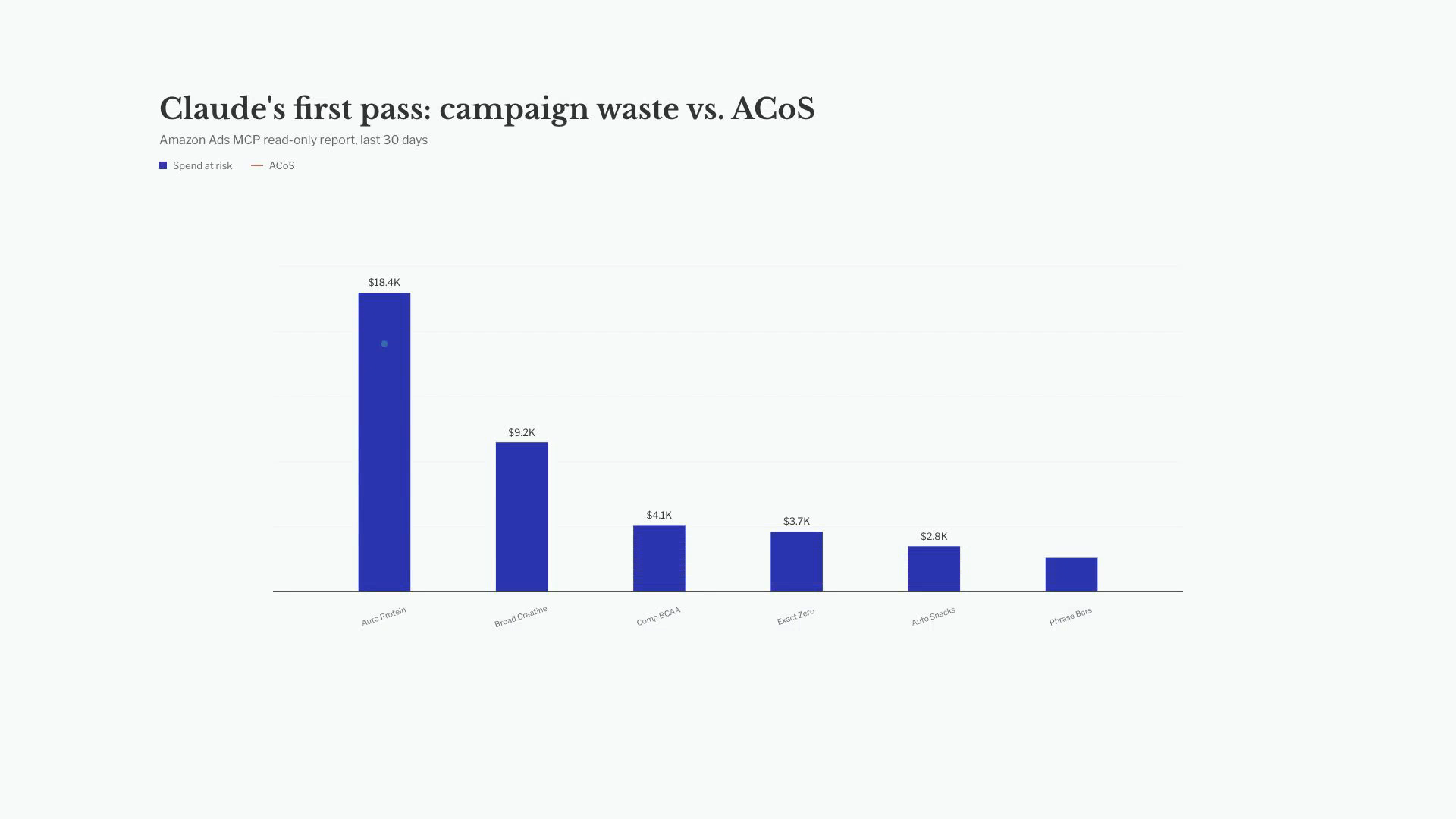
The first lane is campaign waste. Ask the agent to flag every campaign with ACoS above 35% and spend above $200 in the last 30 days, then rank the output by wasted spend. That is not a final strategy. It is a triage list a senior PPC manager can review in minutes.
The second lane is search term mining. Ask it to pull 60 days of search-term data from Auto campaigns, find terms with two or more orders and ACoS below 25%, remove terms already running as Exact Match, and group the rest by parent ASIN.
The third lane is keyword cleanup. Ask it to find every Exact Match keyword with more than 50 clicks in the last 30 days and zero conversions, then show bid, spend, and campaign.
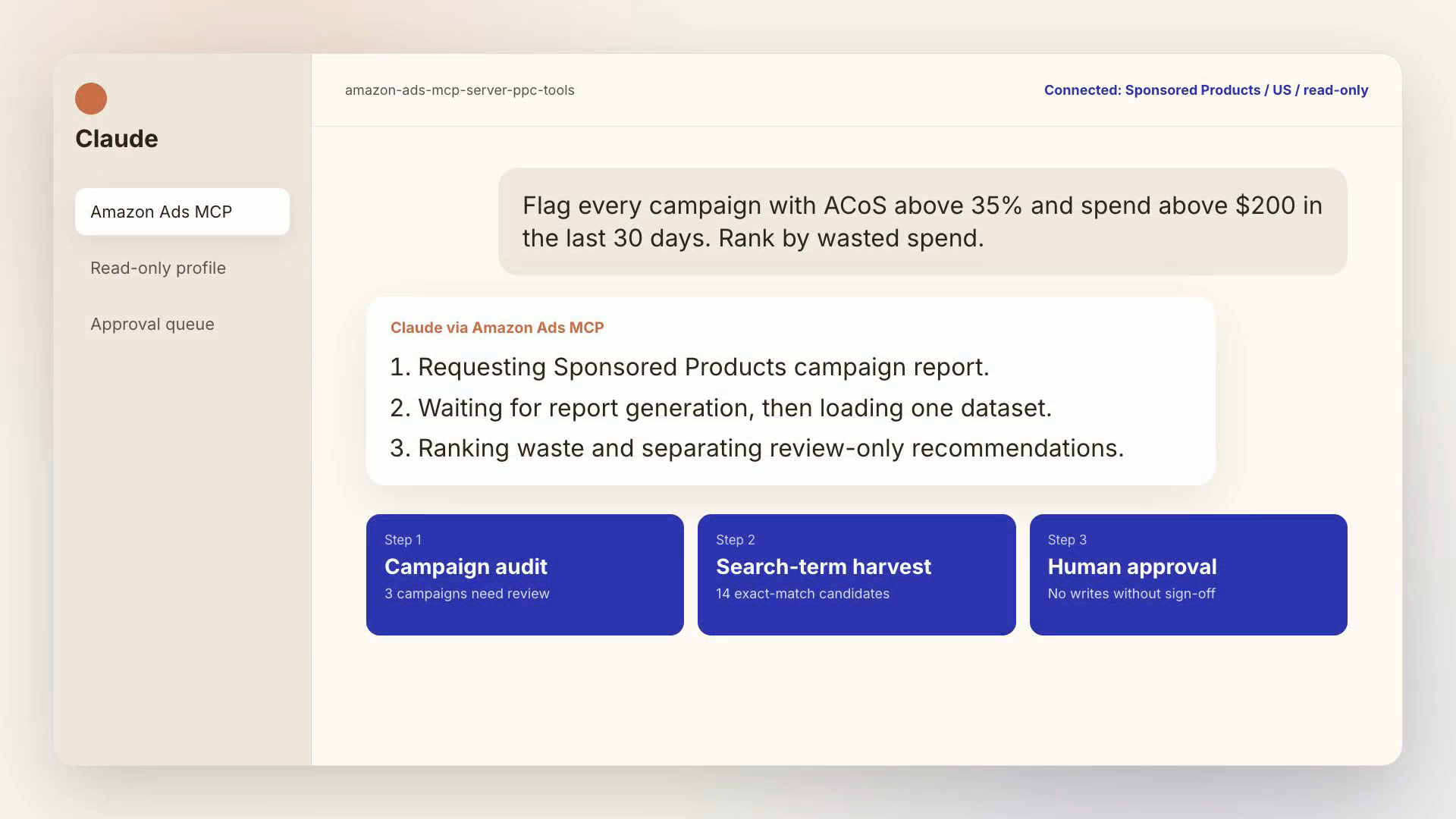
Those three prompts can replace a painful first pass through reports. They do not replace the person who knows the margin, launch context, inventory position, review quality, and category dynamics.
The decision: let the agent find the work. Let the operator approve the action.
How should a PPC team test it without risking the account?
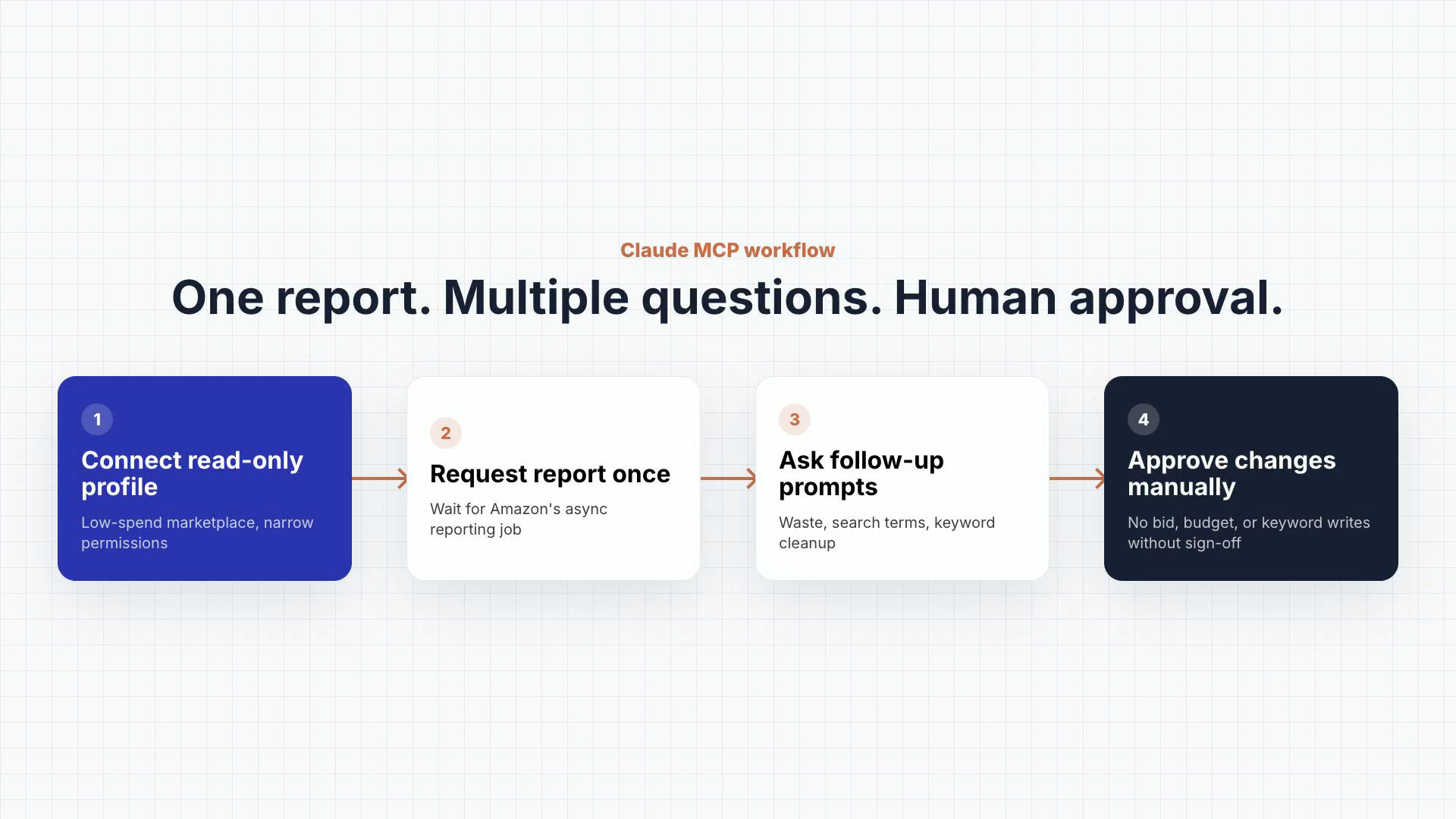
Use read-only access first and point it at a low-spend profile.
That sounds conservative because it is. Amazon says the MCP Server can support campaign creates, updates, and deletes through connected agents: Amazon Ads. That is powerful. It is also exactly why unrestricted write access on day one is a bad idea.
A smart test looks like this:
- Pick one marketplace and one low-spend profile.
- Connect the agent with the narrowest access that still lets it pull reports.
- Ask only read-only questions for the first week.
- Compare the agent's findings against your current PPC workflow.
- Save the useful prompts and reject the ones that produce noisy work.
- Move to assisted writes only when a human approves every change.
The economic reason is obvious. A bad recommendation in a read-only workflow costs review time. A bad write to a live ad account can burn spend, break launch structure, or pause a profitable campaign.
What will teams misunderstand about reporting?
Teams will think the agent is broken when the report is still being generated.
Amazon Ads reporting workflows often involve creating a report request, checking its status, and then downloading the report when it is ready. Amazon's reporting docs are built around that create-and-retrieve flow: Amazon Ads API docs.
That means the best workflow is not "ask one question, pull one report, ask another question, pull another report." That turns MCP into a slow dashboard with extra steps.
Pull the dataset once. Wait for it to finish. Then ask several questions against the same loaded data.
For example, after a 30-day Sponsored Products report is loaded, ask for campaign waste, keyword cleanup, match-type outliers, placement waste, and ASIN-level spend concentration from the same dataset. The agent should not keep asking Amazon for the same report just because the prompt changed.
The decision: separate report generation from analysis. That one habit will make the whole setup feel more reliable.
What does this mean for agencies?
Agencies lose the excuse that basic data access is a premium service.
That is healthy. A serious Amazon PPC partner should not be valuable because they can export a search term report faster than the client. They should be valuable because they know which action is safe, which action is lazy, and which action would improve ACoS while damaging total contribution margin.
This is where ALFI's view is blunt: PPC work has to move from metric watching to profit decisions. A campaign can look inefficient on ACoS and still be worth protecting if it supports organic rank, a high-margin SKU, or a launch window. A keyword can look profitable and still be dangerous if it pulls spend away from a better-converting parent ASIN.
MCP can surface those conflicts faster. It cannot decide your margin tolerance unless you have taught the system your actual economics.
That is why the next layer should include contribution margin by SKU, inventory status, buy box stability, review velocity, PDP readiness, and category seasonality. Without that context, an agent can become a faster way to make shallow PPC decisions.
What should PPC software become now?
PPC software needs to move above the data-access layer.
The next useful tools will not just show the campaign table. They will help teams govern decisions. That means approval queues, change logs, rollback plans, account-specific rules, margin-aware recommendations, and alerts tied to business impact instead of dashboard noise.
A good system should answer questions like:
- Which changes are safe to approve today?
- Which recommendations conflict with inventory or margin constraints?
- Which campaigns are wasting spend versus funding rank?
- Which changes did we make last week, and did they help?
- Which agent recommendations should be blocked by policy?
That is a better product than another chart.
The decision for software buyers: stop paying premium prices for a dashboard unless the tool also improves the quality, control, or speed of decisions.
When should sellers not use MCP for PPC?
Do not use it when the account context is missing.
If your campaign naming is messy, SKU margins are unknown, product groups are inconsistent, and no one knows which campaigns are launch investments versus profit campaigns, an agent will still find patterns. It may also recommend the wrong action with confidence.
Do not use it for unrestricted writes before you have a review process. Do not use it as a shortcut around PPC strategy. Do not use it to cut out the person who understands the brand's economics.
Use it when the task is narrow, the data is loaded, the prompt is clear, and a human can review the recommendation.
That is where it gets useful quickly.
Is the MCP server free?
Amazon says the MCP Server and tools are available in open beta to Amazon Ads partners with active API credentials. That removes the need to pay a third-party tool just to access a dashboard layer, but your own setup, workflow design, and approval process still take work.
Does MCP replace Amazon PPC tools?
It replaces some of the need for dashboard-only tools. It does not replace tools that provide bidding systems, approval controls, profit-aware rules, audit trails, or cross-channel operating workflows.
Can Claude or ChatGPT change live campaigns?
Amazon says connected agents can access capabilities including creating, updating, or deleting campaigns. That is why teams should start with read-only access and move to assisted writes only after human review.
What is the safest first prompt to test?
Start with a campaign waste prompt: "Flag every campaign with ACoS above 35% and spend above $200 in the last 30 days. Rank them by wasted spend." It is easy to verify and tied directly to spend.
Why can report generation feel slow?
Reporting is not always instant. Treat report generation and analysis as separate steps: request the report, wait for it to finish, then ask multiple questions against the loaded dataset.
Should a 7-figure brand cancel its PPC tool?
Not automatically. If the tool is mainly a dashboard, question the spend. If it gives you approval workflows, margin logic, change history, and stronger PPC decisions, it may still earn its place.
What to do this week
- Confirm whether your team has active Amazon Ads API credentials.
- Pick one low-spend profile for a read-only MCP test.
- Run the three prompts in this article against a recent dataset.
- Compare the findings with your current PPC tool or analyst workflow.
- Document which prompts produced usable decisions.
- Add a human approval step before any bid, budget, keyword, or campaign write.
- If you want help building a profit-aware PPC workflow around this, talk to ALFI. The goal is not more automation. The goal is fewer expensive, late decisions.