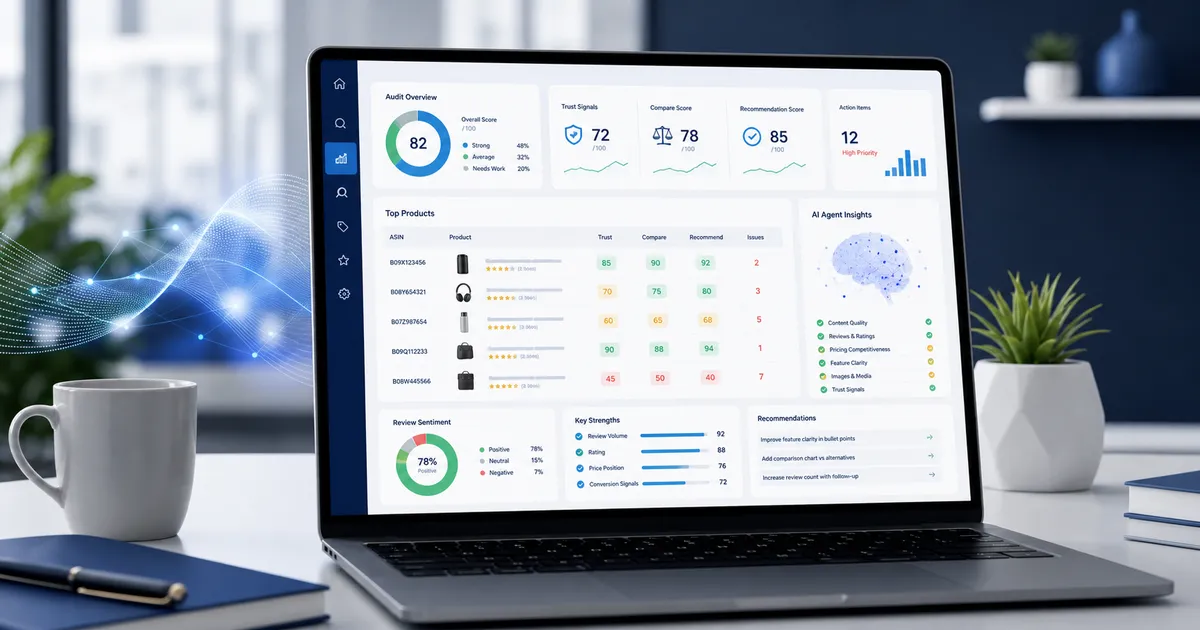
An AI shopping agent Amazon listing audit asks one blunt question: can the assistant understand, compare, trust, match, and recommend your ASIN before the shopper reaches the product page?
That matters because agent-mediated shopping moves part of conversion upstream. Amazon says its shopping assistant can answer product questions, compare options, add items to carts, track prices, and buy at a target price through agentic AI features: Amazon. If your listing does not give the agent clean facts, the answer may favor the ASIN that is easier to explain.
This is not about writing for a bot instead of a buyer. It is about making the buying case obvious enough that a buyer, an algorithm, and an AI answer layer all see the same product.
Key Takeaways
- AI shopping agents are moving product evaluation closer to search, comparison, and cart actions.
- Amazon says its assistant draws from product catalog data, customer reviews, community Q&A, and web information.
- The best audit starts with your top revenue ASINs, not the whole catalog.
- Messy variants, vague specs, weak proof, and missing comparison language create recommendation risk.
- ALFI's view: AI listing readiness is now a conversion layer, not a side project.
Why does agent-mediated shopping change the listing job?
Agent-mediated shopping changes the listing job because the assistant can shape the shopper's shortlist before the product page gets the full chance to sell.
In normal search, a seller worries about ranking, click-through rate, image quality, reviews, price, and conversion. Those still matter. The difference is that an AI shopping layer can answer the shopper's question first, then recommend a smaller set of products.
Amazon says its shopping assistant can search by activity, event, purpose, and use case, and can provide product recommendations: Amazon. That means the buyer may ask "what do I need for a first apartment kitchen?" instead of typing "knife set." Your ASIN has to be legible in that context.
The economic point is simple. If the agent cannot connect your product to the buyer's use case, your product can be technically indexed but practically invisible. You still pay for listing work, content, inventory, and ads, but the recommendation path gets weaker.
The decision: audit the answer an agent could give, not only the keyword fields Amazon can index.
Can the agent understand what the ASIN is?
Start with basic comprehension. If a smart junior operator looked at the listing for 60 seconds, could they explain what the product is, who it is for, what is included, and what makes each variant different?
Most listing problems show up here first. Titles carry too many keywords and too few facts. Bullets mention benefits but skip dimensions, materials, compatibility, flavor count, pack size, ingredients, power source, care limits, warranty, or refill cadence. Images look polished but leave the agent guessing about the facts that actually answer buyer questions.
Amazon says the assistant uses a custom model drawing on Amazon's product catalog, reviews, community Q&As, and information from across the web: Amazon. If those sources disagree, the cleanest answer may come from a competitor with less ambiguity.
Run the first check on your top 10 ASINs. For each one, write a one-sentence plain-English definition. Then check whether the title, first image, first two bullets, attributes, and A+ content all support that definition.
The decision: fix comprehension before persuasion. A product the agent cannot describe cleanly is not ready to be recommended.
Can the agent compare your ASIN against alternatives?
Comparison is where thin listings get exposed.
A shopper rarely asks only "what is this?" They ask which size fits, which material lasts longer, whether it works with a specific device, whether the subscription value makes sense, or why one product costs more than another. If your listing cannot support those comparisons, the agent has to fall back on weaker signals.
Amazon's Buy for Me page shows how far this is moving. Amazon says customers can see relevant product information inside the app for products from brand retailer sites, then request Amazon to purchase the item on their behalf using agentic AI: Amazon. That is a useful signal for sellers: the interface is being built around product information that can travel across surfaces.
For an Amazon listing, comparison facts should not live only in an image with tiny text. Put the major buying criteria into structured listing areas where possible: attributes, bullets, A+ modules, Q&A, and review-backed claims.
Useful comparison fields include size ranges, material differences, ingredient exclusions, warranty terms, compatibility limits, count per pack, cost per use, refill timing, and what is not included. For CPG and supplements, include flavor, serving size, allergen notes, claims discipline, and Subscribe & Save logic.
The decision: write the comparison the shopper is already making in their head.
Can the agent trust the claim?
Trust is not a vibe. It is consistency across the listing, reviews, Q&A, price, and outside facts.
If your bullet says "leakproof" but reviews complain about leaking, the agent has a conflict. If your image says "fits all models" but Q&A has three compatibility exceptions, the agent has a conflict. If your list price is always struck through and the assistant can check price history, the shopper may question the deal.
Amazon says its assistant can tell shoppers whether they are getting the best price, find deals, and auto-buy items at a set price: Amazon. Price trust now belongs in the listing readiness conversation, not only the promo calendar.
Pull the top review themes for each priority ASIN. Separate them into proof themes and objection themes. Proof themes are reasons buyers believe the product works: sturdy, accurate sizing, good flavor, fast setup, clean ingredients. Objection themes are reasons buyers hesitate: leaking, confusing instructions, missing parts, broken packaging, poor fit, bad taste.
Then decide where each theme belongs. Some proof themes should appear in bullets or A+ content. Some objections need a clearer image, Q&A answer, attribute update, or packaging fix. Some claims should be softened because the reviews cannot support them.
The decision: do not ask the agent to trust a claim your own review section is undermining.
Can the agent match the ASIN to the shopper's use case?
Use-case matching is the difference between a product being eligible and a product being the right answer.
Traditional keyword work often stops at product nouns. Agent shopping pushes toward buyer jobs. The query may be "starter cookware for a small apartment," "protein powder that mixes well with water," "gift for a runner who travels," or "non-slip mat for an older dog." The ASIN needs enough context to match the job.
This is where buyer questions, reviews, Q&A, search terms, and prompt-style research become useful. Amazon Ads says Sponsored Products prompts and Sponsored Brands prompts surface relevant details before shoppers need to ask, and that sellers can review prompt text plus performance metrics in Ads Console: Amazon Ads. Even if prompt volume is still uneven, the wording gives sellers a window into natural-language buying intent.
Build a use-case map for each top ASIN. Use five columns: buyer type, situation, constraint, reason to choose, reason to hesitate. A supplement brand might map "busy parent," "morning routine," "no added sugar," "easy serving format," and "taste concern." A home goods brand might map "small apartment," "limited storage," "foldable design," "easy cleaning," and "durability concern."
The decision: build around the shopper's job, not just the product category.
Can the agent recommend the ASIN without overreaching?
Recommendation is the last gate. The agent has to be able to say why this product fits without making a claim the listing cannot support.
That is where many brands get sloppy. They want the listing to sound premium, category-leading, or perfect for everyone. Agents need sharper boundaries. A product that is clear about who it is for can be recommended more confidently than a product that tries to be for every shopper.
Write a recommendation sentence for each priority ASIN:
"Recommend this ASIN when the shopper wants [use case], cares about [constraint], and is willing to accept [tradeoff]."
Then write the inverse:
"Do not recommend this ASIN when the shopper needs [unsupported use case], [missing feature], or [price/size/material constraint]."
This is uncomfortable, but it protects conversion. If the wrong shopper buys because the listing overpromised, the cost shows up later in returns, review drag, support tickets, and wasted ad spend.
ALFI uses this type of triage because most 7-8 figure brands do not need a full catalog rewrite first. They need the top revenue ASINs cleaned up in the order that protects contribution margin. Fix the ASINs where traffic, ad spend, review risk, and margin exposure overlap.
The decision: a narrower recommendation that converts profitably beats a broad promise that creates returns.
How should you prioritize the audit?
Do not start with every listing. That is how a useful AI readiness project turns into a content swamp.
Start with the ASINs that can move money this month. Pull your top sellers by revenue, highest ad-spend ASINs, highest-return ASINs, and products with declining conversion despite steady traffic. Where those lists overlap, start there.
Score each ASIN from 1 to 5 on five questions:
- Can the agent understand the product?
- Can the agent compare it against alternatives?
- Can the agent trust the claims?
- Can the agent match it to clear use cases?
- Can the agent recommend it without overreaching?
Anything scoring 3 or lower on a high-revenue ASIN deserves work before you polish lower-volume products. This keeps the project tied to cash instead of content vanity.
For most brands, the first fixes are not exotic. Clean attributes. Rewrite the first two bullets. Add missing specs. Improve variant naming. Add a comparison module. Answer recurring Q&A. Turn review themes into clearer proof. Remove claims the reviews do not support. Bring PPC prompt learnings into listing content.
The decision: sequence by revenue, ad spend, margin, and risk. Not by which listing is easiest to rewrite.
Where does ALFI fit into this?
AI listing readiness is not a content trend. It is a profit protection exercise.
The brands that feel this first are usually established brands with enough ASINs, variants, reviews, ads, and channel complexity that the listing no longer tells one clean story. The catalog grew. The content patched itself together. The ad account kept spending. Then the buyer journey changed.
ALFI's role is to bring the listing, PPC, margin, and AI-search layer into the same operating view. We are not interested in rewriting every bullet because a trend report said AI is coming. We care about which ASINs are most exposed, which gaps are costing conversion, and which fixes protect profit first.
If your top ASINs are carrying the business, treat this as an audit. If your ad spend is rising while conversion is flat, treat this as a margin issue. If your product is strong but difficult to explain, treat this as a recommendation risk.
If you want senior operators to pressure-test your top ASINs through this lens, book a call with ALFI. Bring your top SKUs, current conversion trend, and PPC spend. We will tell you where the listing is making the agent's job harder.
What is an AI shopping agent Amazon listing audit?
It is a structured review of whether an AI shopping assistant can understand, compare, trust, match, and recommend your ASIN. The goal is not to write for machines. The goal is to make the buyer case clear enough that machines do not distort it.
Is this different from Amazon listing work?
Yes, but it builds on the same foundation. Standard Amazon listing work focuses on keyword relevance, content quality, images, A+ content, conversion, and retail readiness. AI listing readiness adds natural-language questions, comparison logic, review themes, Q&A, prompt data, and recommendation risk.
Should every ASIN get an AI readiness audit?
No. Start with the ASINs that affect revenue, ad spend, margin, returns, or strategic growth. Auditing the whole catalog before fixing the top money products is usually wasted motion.
What data should sellers use for the audit?
Use listing content, product attributes, Brand Analytics, search-term data, Sponsored Products prompt data where available, buyer questions, Q&A, review themes, returns data, and PPC performance. The useful answer is usually hiding across multiple places, not in one report.
When should a seller not rewrite the listing?
Do not rewrite first when the problem is actually price, inventory, review quality, product-market fit, or a broken campaign structure. Listing edits cannot save an ASIN that is economically uncompetitive or operationally weak.
How often should this audit run?
Run it monthly for top revenue ASINs and before major launches, Prime Day, holiday pushes, new variant rollouts, or paid traffic increases. For lower-volume products, run it when conversion, returns, or buyer questions show a pattern.
What to do this week
- Pick your top 10 ASINs by revenue and ad spend.
- Score each ASIN on understand, compare, trust, match, and recommend.
- Pull the top five review themes and top five Q&A gaps for each priority ASIN.
- Rewrite the first two bullets where they fail to answer buyer questions.
- Add missing specs, compatibility details, variant differences, and use-case language.
- Check whether Sponsored Products prompt data exposes questions your listing does not answer.
- Book a working audit with ALFI if the gaps touch your top revenue products.